


Understanding
Big Behaviours Pilot Course
$49.00
What is it?
A collection of short, bite-sized videos created to gently challenge the way we think about ‘big behaviours’.
You’ll also get a downloadable workbook designed to help you recognise your own triggers and patterns of reaction — building greater empathy, emotional awareness and understanding, so you’re better equipped to support others.
Purpose:
To help parents, carers, and educators understand that all behaviour is a form of communication — even when it looks messy, loud, or confronting.
This course invites you to explore:
- what a behaviour might be trying to tell us,
- how to respond with curiosity instead of control,
- and how to truly see the person behind the behaviour.
My hope is that, through these lessons, you’ll begin to feel more confident, compassionate and equipped to support neurodivergent children and adults who express themselves through big behaviours.
What do I need to do?
- Add to Cart 👇 then Register for the Course (links will be provided at checkout & in emails)
- Start the course
- Download the workbook
- Work your way through the series of short videos (2-6mins each, 45 mins total)
- Take notes in the workbook (personal or feedback) as you go
- Go through the workbook activities – it’s up to you if you completely them or not
- Give feedback in the final topic of both lessons 💕💕💕
videos
The Pilot Course is made up of 13 short videos 2-6mins long (45mins total)
They look like this:
lessons & topics
included in the Pilot Course:
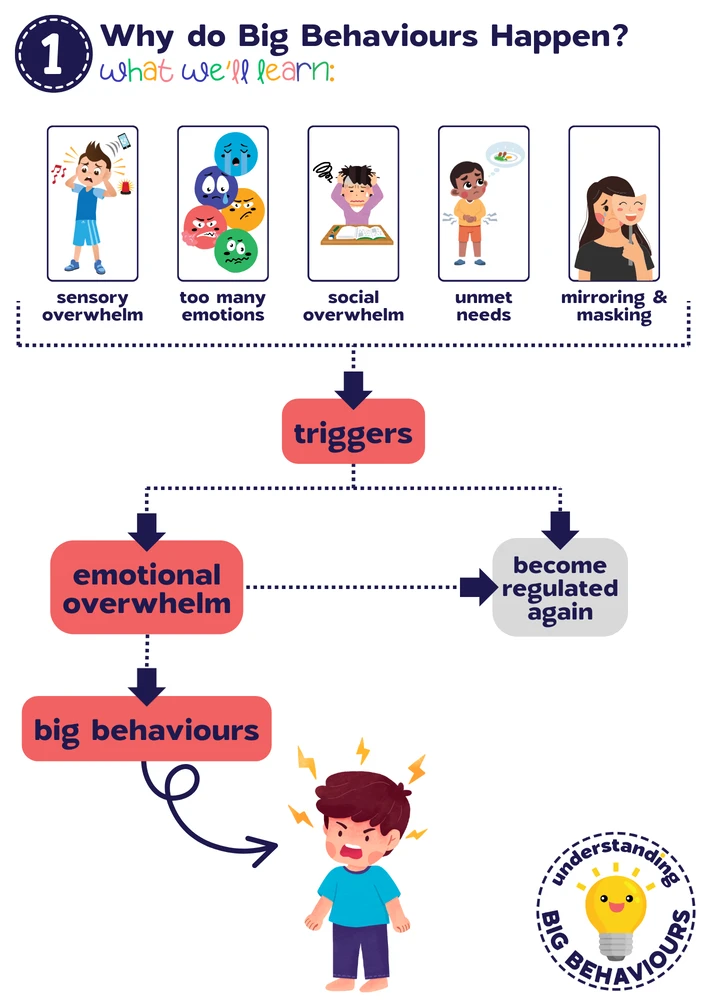
Why Do Big Behaviours Happen?
Summary:
Lesson One dives into the different types of triggers that can lead to emotional overwhelm, helping us understand how these triggers influence behaviour.
We look at the Iceberg Model where behaviours are just the 'tip of the iceberg' - but what's actually going on underneath?
Keywords | Topics:
- Triggers
- Sensory overwhelm
- Too many emotions
- Unmet needs (with Maslow's Hierarchy of Needs)
- Social Overwhelm
- Mirroring & Masking
- Emotional overwhelm
Workbook:
- Discover your triggers
- What triggers your family members/clients/students?
- Trigger tracker - what happens moments before a 'big behaviour'
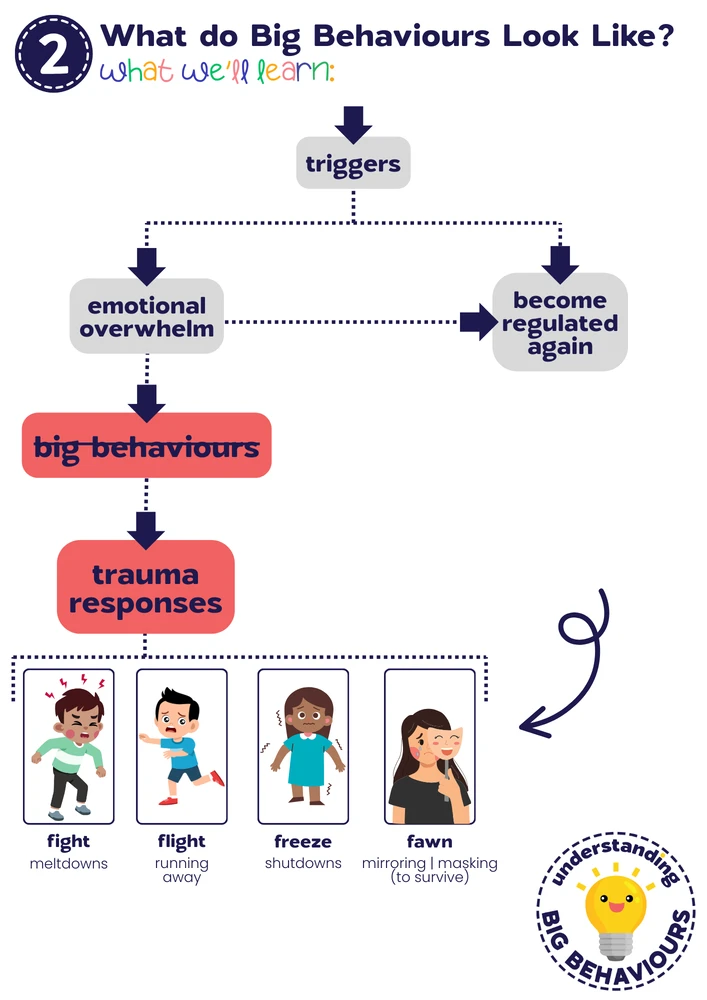
What Do Big Behaviours Look Like?
Summary:
Lesson Two helps us understand that big behaviours like meltdowns, shutdowns, running away, or people-pleasing aren't bad choices—they're trauma responses. When we recognise this, we can shift our response from frustration to compassion.
Instead of reacting, we share our calm, meet their need for safety, and remember to see the person, not just the behaviour.
Keywords | Topics:
- Trauma responses
- Fight - Meltdowns (inc. meltdowns vs tantrums)
- Flight - Running away/avoiding
- Freeze - Shutdowns
- Fawn - Masking & mirroring to survive
- Movement between trauma responses eg: Fight to Freeze
We look at all 4 Trauma Responses:
- What it looks like
- When it happens
- What to do
- What no to do
- Why we don't reason during a trauma response
Workbook
- Begin to understand your own trauma responses and reactions
- What do you need in order to feel safe?
- Explore trauma responses of those in your family or in your care
- What do they need in order to feel safe?
lessons & topics
in the full Course (coming 2026):
Why Do Big Behaviours Happen?
Summary:
Lesson One dives into the different types of triggers that can lead to emotional overwhelm, helping us understand how these triggers influence behaviour.
We look at the Iceberg Model where behaviours are just the 'tip of the iceberg' - but what's actually going on underneath?
Keywords | Topics:
- Triggers
- Sensory overwhelm
- Too many emotions
- Unmet needs (with Maslow's Hierarchy of Needs)
- Social Overwhelm
- Mirroring & Masking
- Emotional overwhelm
Workbook:
- Discover your triggers
- What triggers your family members/clients/students?
- Trigger tracker - what happens moments before a 'big behaviour'
What Do Big Behaviours Look Like?
Summary:
Lesson Two helps us understand that big behaviours like meltdowns, shutdowns, running away, or people-pleasing aren't bad choices—they're trauma responses. When we recognise this, we can shift our response from frustration to compassion.
Instead of reacting, we share our calm, meet their need for safety, and remember to see the person, not just the behaviour.
Keywords | Topics:
- Trauma responses
- Fight - Meltdowns (inc. meltdowns vs tantrums)
- Flight - Running away/avoiding
- Freeze - Shutdowns
- Fawn - Masking & mirroring to survive
- Movement between trauma responses eg: Fight to Freeze
We look at all 4 Trauma Responses:
- What it looks like
- When it happens
- What to do
- What no to do
- Why we don't reason during a trauma response
Workbook
- Begin to understand your own trauma responses and reactions
- What do you need in order to feel safe?
- Explore trauma responses of those in your family or in your care
- What do they need in order to feel safe?
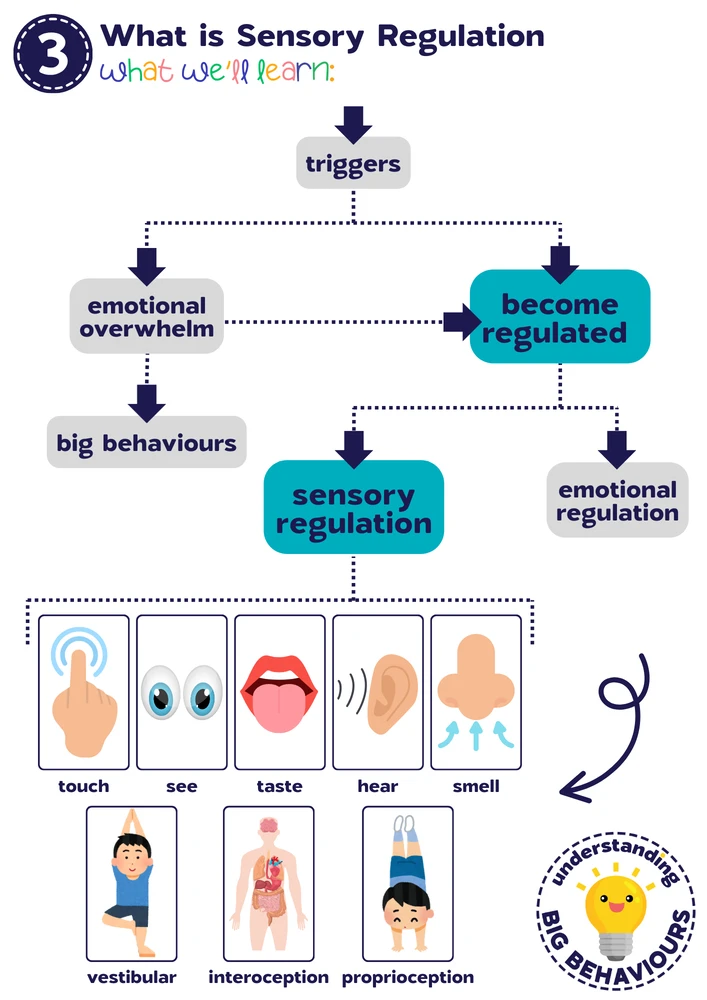
What is Sensory Regulation?
Summary:
Lesson Three unpacks what sensory regulation really means. We explore the difference between being well-regulated and dysregulated, and how sensory triggers can throw us off balance. You'll learn how sensory seeking and sensory aversions impact emotions and behaviour—giving you practical insight into what’s really going on beneath the surface.
Keywords | Topics:
- Sensory regulation
- 8 senses including interoception, proprioception, vestibular
- Dysregulated to well regulated
- Sensory seeking & sensory aversions
- Sensory tools to
- Get going
- Calm down
Workbook:
- What helps you to find calm when you feel agitated or triggered?
- What helps you to get going when you feel stuck?
- What helps others in your world/care to find calm when they appear agitated or triggered
- What helps them to get going when they appear stuck?
What is Emotional Regulation?
Lesson Four explores emotional regulation - what it is, why it matters, and how it develops over time. We dive into how emotions show up in the body, what it looks like to be emotionally regulated (vs. overwhelmed), and how we can support children (and ourselves) in recognising and responding to big feelings in safe, healthy ways.
Keywords | Topics:
- Sensory regulation vs emotional regulation
- Understanding emotions
- Labelling emotions
- Stimming
- Co-regulation
- Self regulation
Workbook:
- Where do you struggle to self regulate?
- What could you add into your day to help you stay regulated?
- What are your warning signs that you are becoming dysregulted?
- Where do you struggle to co-regulate?
- Labelling emotions activities (where labelling emotions needs to be taught before being able to understand them)
- Where do people in your world/care struggle to self regulate?
- What could you help add into their day to help them stay regulated?
- What are their warning signs that they are becoming dysregulted?
- Where do they struggle to co-regulate?
Start Building Your Sensory Profile
Lesson Five breaks down each of our eight senses - including the hidden ones like interoception, proprioception and vestibular - so we can start to truly understand what keeps us calm, what tiggers us, and why.
From there, we begin to build our own sensory profile, before looking at how to support the children in our care by identifying and meeting their unique sensory needs.
Keywords | Topics:
- Touch
- Smell
- Sight
- Taste
- Sound
- Interoception
- Proprioception
- Vestibular
Understanding Your Sensory World (For Each Sense):
- What you like | What you seek out | Where you need more input
- What you dislike | What you avoid | What makes you feel overloaded
- Triggers to avoid
- What overwhelm looks like
Workbook
- Build your sensory profile
- Build a sensory profile for someone in your world/care
Sensory Profile: Understand Sensory Tools
Lesson Six introduces a range of sensory tools and strategies that can be used at home, in the classroom, or in the clinic to support both sensory and emotional regulation.
We continue developing our sensory profiles by adding tools and techniques that help us - and the children in our care - feel safe, calm, and in control. We also explore what to do in the moment when big behaviours arise, so we can respond with confidence and care.
Keywords | Topics:
- Weighted blankets and toys
- Movement breaks
- Fidgets
- Sensory bottles
- Squeezing/deep pressure
- Headphones
- Sunnies
- Crunchy Foods
- Soft foods
- Cubbies and tents
- Comfort teddies/toys
- Divider plates
- Everyday things to avoid
Understanding Your Sensory World (For Each Sensory Tool):
- When to use them
- How to use them
- Why they work
- Matching sensory tools to certain behaviours
Disclaimer:
- What works for one won't work for all and that's ok
- What works one day might not work the next and that's ok
Workbook
- Continue building your sensory profile
- Continue building a sensory profile for someone in your world/care
Sensory Profile: Co-regulation & Self Regulation
In our final lesson, we focus on a key piece of the puzzle: identifying what support needs to come from us (co-regulation) and what a child/person might be ready to manage themselves (self-regulation).
This is about setting realistic and respectful expectations - especially for neurodivergent children - and recognising that some needs will always require external support. We’ll reflect on each sensory profile and clearly define which strategies belong to the adult, and which are being built as skills in the child.
Because understanding what’s truly achievable right now helps us:
-
Reduce frustration (for everyone),
-
Create safer, calmer environments,
-
And celebrate growth without pushing independence too early.
This lesson helps you walk away with a practical, strengths-based plan that honours both current needs and future goals.
Keywords | Topics:
- Co-regulation
- Self Regulation
- Moving from co-regulation to self regulation (where possible)
Workbook
- Finish building your sensory profile
- Finish building a sensory profile for someone in your world/care